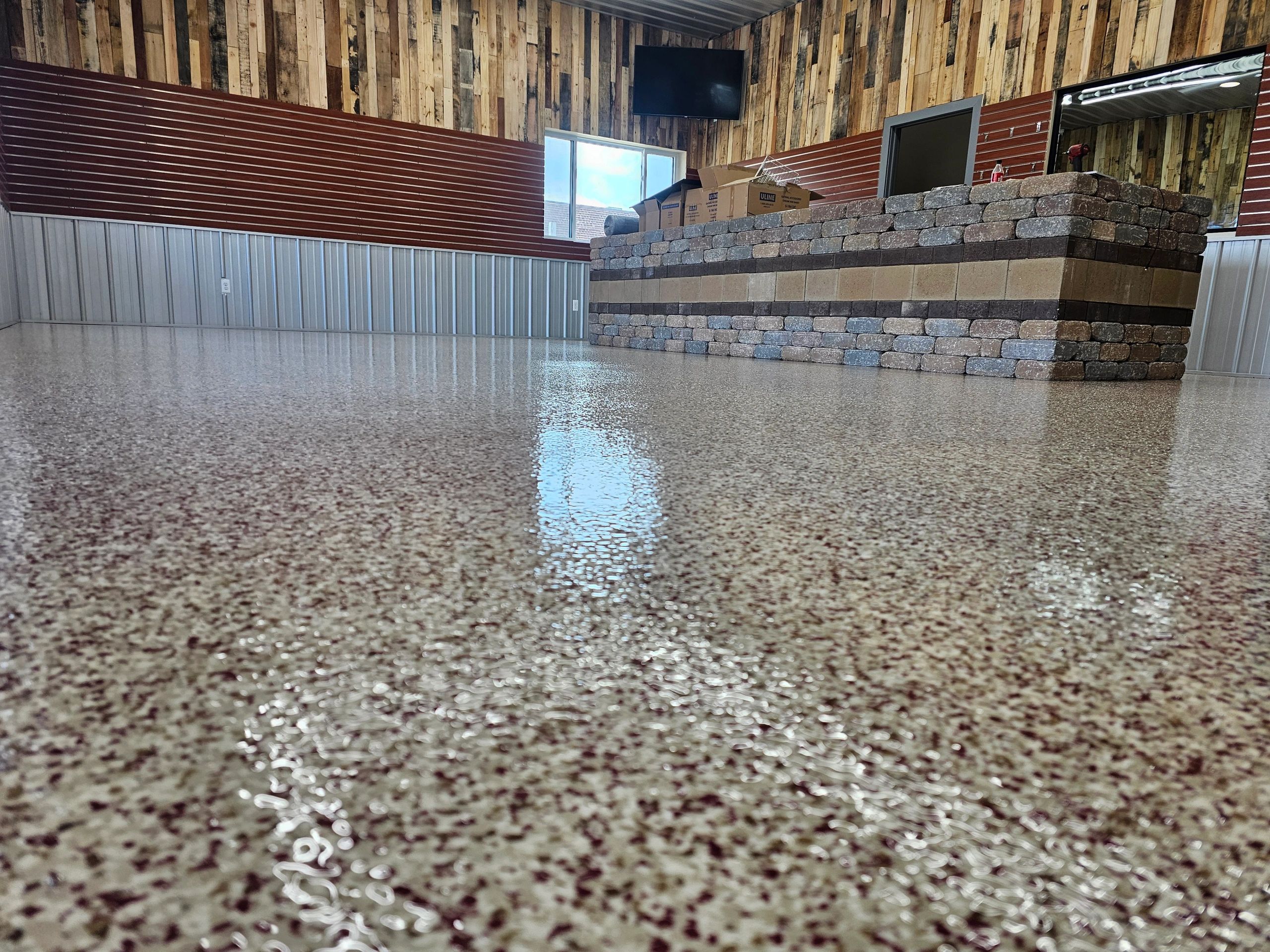
Walk into any big-box hardware store and you'll see epoxy kits stacked on shelves. They're cheap. They're convenient. They're also not the same as professional-grade epoxy. Understanding the difference helps you evaluate every contractor quote and avoid the false economy of cheap materials.
Water-Based vs. 100 Percent Solids Epoxy
Retail epoxy is often water-based. Manufacturers add water to stretch the resin and reduce cost. Water-based epoxy is easier to apply, smells less, and is cheaper. But here's the problem: water evaporates.
As water evaporates from the curing epoxy, the coating shrinks and thins. A thick application becomes thin. The final mil thickness is half or less than specified because the water is gone.
Professional epoxy is 100 percent solids (or close to it). Everything in the can becomes the hardened coating. No water to evaporate, no shrinkage, no wasted thickness. The epoxy you apply is the epoxy you get.
This is why professional floors last longer. They're thicker, denser, and harder because the material is solid, not diluted.
Mil Thickness, The Critical Spec
A "mil" is one-thousandth of an inch. Professional epoxy systems are specified by mil thickness, not by the number of "coats."
A professional residential epoxy system is 20 to 25 mils total. This includes primer, base coat, and topcoat, all measured in mils. A commercial system is 30 to 50 mils. An industrial system is 50 to 100 mils.
Consumer kits rarely specify mil thickness. They say "one coat" or "two coats." A single coat of retail epoxy is often 3 to 5 mils. Two coats might reach 8 to 10 mils total. This is half or less than a professional system.
Thinner coating means earlier wear, faster degradation, and shorter lifespan. A 5-mil coat shows scuffs and marks within years. A 25-mil coat resists damage for decades.
Consumer vs. Commercial Chemistry
Professional epoxy contains premium binders, high-quality pigments, and additives for durability. Consumer epoxy contains less expensive binders, more filler, and minimal additives.
This difference shows up in performance. Professional epoxy is harder, resists chemicals and abrasion better, and maintains gloss longer. Consumer epoxy yellows faster, scuffs easier, and breaks down under UV exposure more quickly.
Product Supply Chain
Professional epoxy comes from manufacturers with serious quality controls. We source our epoxy from suppliers who test every batch for viscosity, cure time, hardness, and adhesion. If a batch doesn't meet spec, it's rejected.
Consumer epoxy comes from mass-market suppliers where batch-to-batch consistency is not guaranteed. You might get a good kit or a mediocre one. There's no QA process for DIY products.
Why We Refuse to Use Cheap Materials
We could source generic epoxy at half the cost we currently pay. We'd improve margins significantly. But we don't.
Every floor we install carries our name and our 2-year warranty. If we install cheap epoxy and it fails at year three, that's a problem we created. A homeowner's floor peeling reflects on us, and we won't accept that.
We use premium materials because we want our floors to last. Longevity is the ultimate marketing tool. A homeowner with a floor that's still perfect at year 10 tells everyone about it. A homeowner with a failed floor tells more people why to avoid us.
Premium materials cost more upfront but deliver better results and fewer callbacks. That's good business and good ethics.
What to Ask a Contractor About Their Products
If you're getting quotes from multiple contractors, ask these questions.
First: "What brand and product line are you using?" Legitimate contractors name their products. Generic answers like "industrial epoxy" or "premium coating" are red flags.
Second: "What is the mil thickness of your system?" Look for 20 mils or higher. Anything below 15 mils is consumer-grade or a compromised system.
Third: "Is it 100 percent solids or water-based?" 100 percent solids is the right answer for longevity.
Fourth: "Can you provide the technical data sheet?" Real professionals have product specs. They should be happy to share them.
Fifth: "What warranty do you offer?" A contractor confident in their materials offers a 2-year or longer warranty. No warranty is a red flag.
The 15 to 20 Year Result
The difference between premium and cheap epoxy becomes obvious over time. Premium epoxy still looks great at year 5 and year 10. Cheap epoxy shows wear, chalking, and fading within a few years. By year 10, cheap epoxy is peeling or soft.
The homeowner who invested in premium materials doesn't regret it. The homeowner who went with the cheapest quote often regrets it after a few years and ends up paying twice.
Your epoxy floor is a 15 to 20 year investment. Materials matter. We've chosen ours. Let's talk about why we think it's the right choice for your floor.