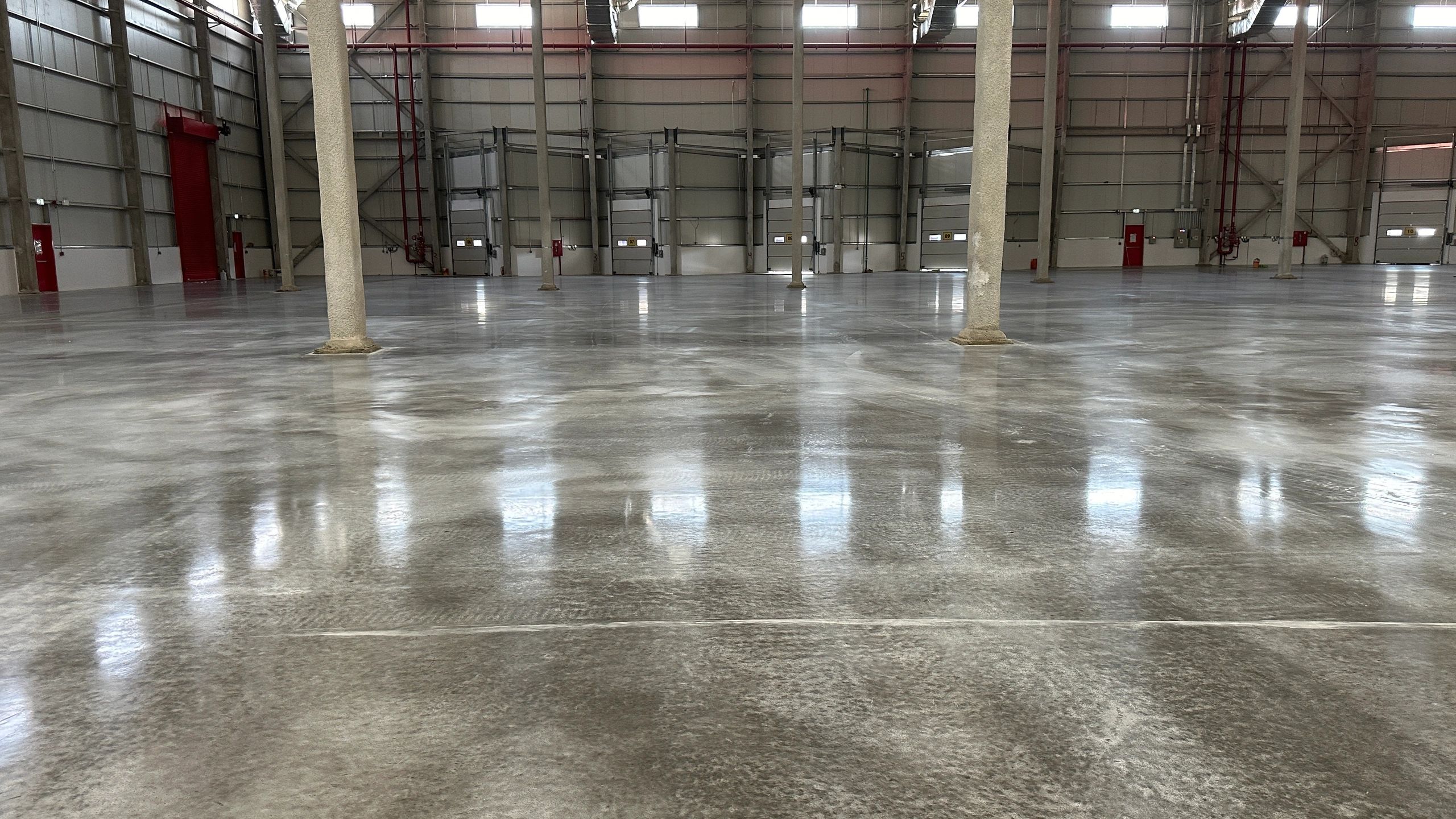
If epoxy floors had a foundation, it would be surface preparation. And if surface preparation had a foundation, it would be diamond grinding. Everything else you'll hear about epoxy, coatings, colors, and warranties depends on this one step. Understanding why diamond grinding matters will change how you evaluate every epoxy quote.
What Is Diamond Grinding?
Diamond grinding is the mechanical removal of the top layer of concrete using rotating heads set with industrial diamond segments. It sounds simple. In practice, it's the most important step in the entire process.
A walk-behind or handheld grinder removes concrete at a controlled depth, exposing fresh aggregate and creating a mechanically textured surface. This texture is called the Concrete Surface Profile, or CSP.
CSP 3 and CSP 4, Explained
The Concrete Society defines CSP on a scale from 1 to 5. CSP 1 is nearly smooth. CSP 5 is deeply profiled, almost rough.
For epoxy flooring, we target CSP 3 or CSP 4. This means the concrete has visible aggregate, visible sand between the aggregate, and visible small aggregate at the bottom of the profile. It looks and feels like coarse sandpaper.
This texture is the mechanical key. The epoxy resin flows into the pores and valleys, hardens, and locks in place. It's not gluing to the concrete surface. It's mechanically interlocked with the concrete structure. That's permanent adhesion.
Why Grinding Creates Permanent Adhesion
Concrete has a top "skim" of fine dust and laitance, a thin layer of weak cement particles. Epoxy applied to this skim sits on top of the weakest part of the concrete and will eventually peel or delaminate.
Diamond grinding removes this skim and exposes the solid concrete and aggregate beneath. The resin then flows into the pores of the solid concrete, creating mechanical interlock at a depth of one-eighth to one-quarter inch. Once cured, the epoxy is part of the concrete, not just sitting on it.
This is why properly ground floors last 15 to 20 years or longer. They don't fail at the interface. They fail only if the coating itself breaks down, which is unlikely with premium materials.
What Happens Without Grinding
We regularly receive calls from homeowners whose DIY or cheap contractor epoxy failed. We always find the same cause: no grinding. The epoxy was applied to a cleaned but not mechanically profiled surface. Without CSP 3 or 4 profile, adhesion is only as good as the concrete skim, which is weak.
The peeling typically starts at the edges or in high-traffic areas where the epoxy flexes or dirt gets under the edge. Once it starts, it spreads. Within months or a couple of years, large areas have delaminated. The floor is soft underfoot, unsightly, and failing.
The fix is complete removal, re-grinding (finally), and reinstallation. That costs $3,000 to $5,000 and could have been prevented by grinding the first time.
Acid Etching vs. Diamond Grinding
Acid etching is cheaper and faster. A chemical etch (usually muriatic acid) reacts with the concrete, creating a porous surface. Homeowners like it because it's simple and DIY-friendly.
But acid etching is superficial. It opens the skim but doesn't remove it. It's like sanding wood with 80-grit paper instead of 40. It helps adhesion but doesn't create the mechanical profile that lasts decades.
We've never used acid etching. We use diamond grinding because it's the right way. Yes, it's more expensive and time-consuming. Yes, it requires equipment and skill. But the result is a floor that actually lasts.
The Equipment Involved
Professional diamond grinding requires a concrete grinder, typically 400 to 800 pounds, with industrial diamond segments bonded to rotating heads. Different grit sizes (50, 100, 120 grit) are used in sequence to achieve the proper profile.
A good grinder costs $8,000 to $20,000. Adding in training, maintenance, and operation costs, professional grinding is not a DIY option for most homeowners. This is where professional contractors provide value.
Our Commitment
We grind every floor. No exceptions. No shortcuts. No acid etching as a substitute. We arrive with our grinder, assess the concrete, and remove whatever is necessary to achieve CSP 3 profile at minimum.
This takes time. It adds cost. But it's the foundation of every floor we build. We won't install premium epoxy over inadequate prep. That would be compromising our own work.
The Long-Term Payoff
Diamond grinding is the single best investment in the longevity of your epoxy floor. A properly ground floor will last 15 to 20 years or longer. A poorly prepped floor fails in 5 to 10 years, costing you more to fix than the original installation.
When you're evaluating epoxy quotes, ask about grinding. What equipment do they use? What profile are they targeting? If the answer is "light acid etch," walk away. If the answer is "CSP 3 diamond grind," you've found a contractor who takes their work seriously.
We're ready to build your floor right, from the ground up. Let's talk about the proper way to prepare your concrete.